> ## Documentation Index
> Fetch the complete documentation index at: https://docs.kubiks.ai/llms.txt
> Use this file to discover all available pages before exploring further.
# Upstash QStash
> OpenTelemetry instrumentation for Upstash QStash message queues
## Overview
`@kubiks/otel-upstash-queues` provides comprehensive OpenTelemetry instrumentation for [Upstash QStash](https://upstash.com/docs/qstash). Capture spans for both message publishing and consumption with detailed operation metadata and delivery tracking.
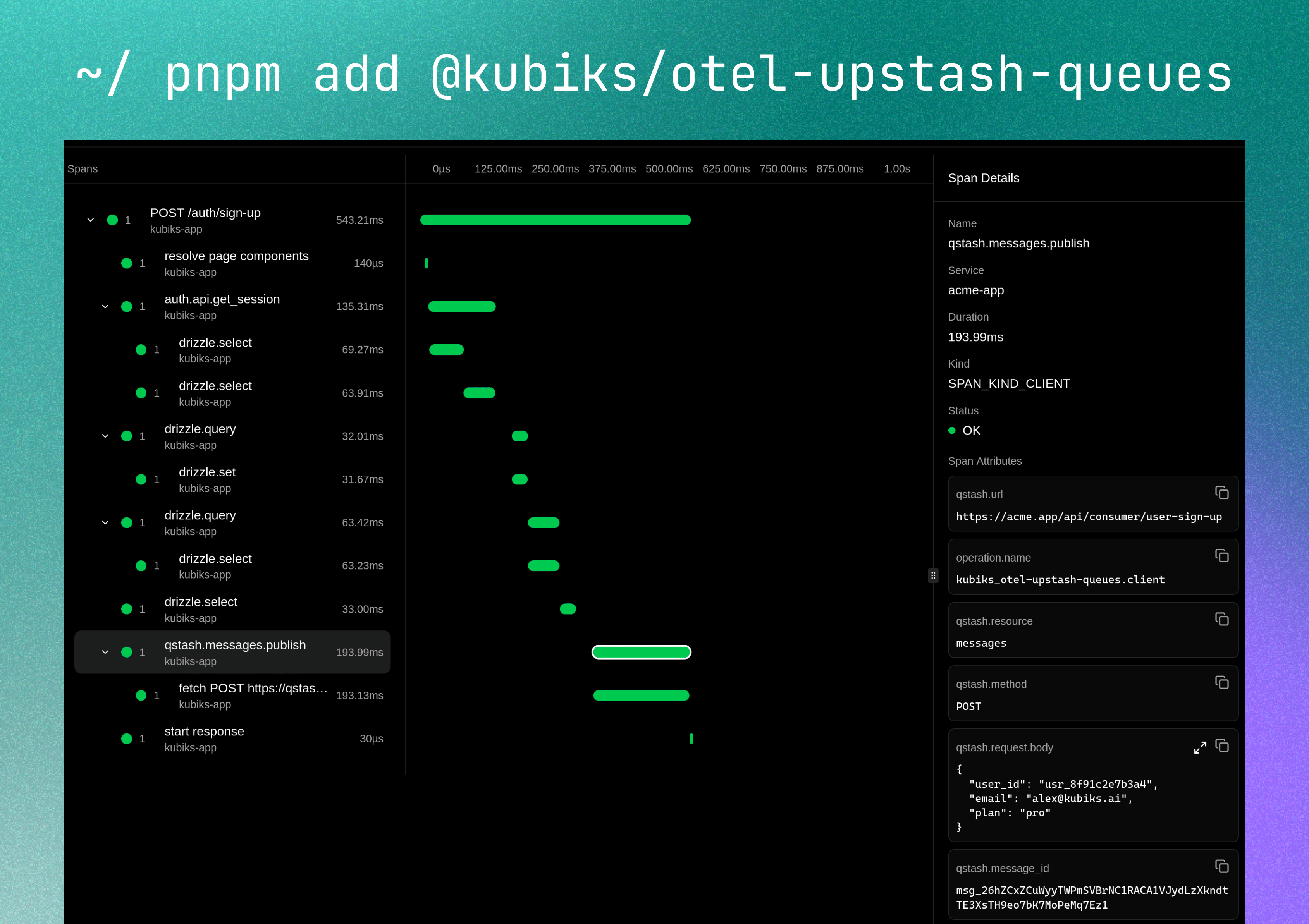 Visualize your message queue operations with detailed span information including message publishing, callbacks, and delivery tracking—from producer to consumer.
## Installation
```bash npm theme={null}
npm install @kubiks/otel-upstash-queues
```
```bash pnpm theme={null}
pnpm add @kubiks/otel-upstash-queues
```
```bash yarn theme={null}
yarn add @kubiks/otel-upstash-queues
```
**Peer Dependencies:** `@opentelemetry/api` >= 1.9.0, `@upstash/qstash` >= 2.0.0
## Quick Start
### Publishing Messages
```typescript theme={null}
import { Client } from "@upstash/qstash";
import { instrumentUpstash } from "@kubiks/otel-upstash-queues";
const client = instrumentUpstash(
new Client({ token: process.env.QSTASH_TOKEN! })
);
await client.publishJSON({
url: "https://your-api-endpoint.com/process-image",
body: { imageId: "123" },
});
```
`instrumentUpstash` wraps the QStash client instance you already use—no configuration changes needed. Every SDK call creates a client span with useful attributes.
### Consuming Messages
```typescript theme={null}
// app/api/process/route.ts
import { verifySignatureAppRouter } from "@upstash/qstash/nextjs";
import { instrumentConsumer } from "@kubiks/otel-upstash-queues";
async function handler(request: Request) {
const data = await request.json();
// Process your message
await processImage(data.imageId);
return Response.json({ success: true });
}
// Instrument first, then verify signature
export const POST = verifySignatureAppRouter(instrumentConsumer(handler));
```
`instrumentConsumer` wraps your message handler to trace message consumption, creating a SERVER span for each message received and processed.
## What Gets Traced
This instrumentation provides two main functions:
Wraps the QStash client to trace **message publishing** with `SpanKind.CLIENT`
Wraps your message handler to trace **message consumption** with `SpanKind.SERVER`
## Configuration
### With Body Capture
Optionally capture request/response bodies for debugging:
```typescript theme={null}
const client = instrumentUpstash(
new Client({ token: process.env.QSTASH_TOKEN! }),
{
captureBody: true, // Enable body capture (default: false)
maxBodyLength: 2048, // Max characters to capture (default: 1024)
}
);
```
Body capture is **disabled by default** to protect sensitive data. Only enable in secure, development environments.
## Span Attributes
### Publisher Spans (`instrumentUpstash`)
| Attribute | Description | Example |
| ----------------------------- | ------------------------------------------- | --------------------------------- |
| `messaging.system` | Constant value `qstash` | `qstash` |
| `messaging.operation` | Operation type | `publish` |
| `qstash.resource` | Resource name | `messages` |
| `qstash.target` | Full operation target | `messages.publish` |
| `qstash.url` | Target URL for the message | `https://example.com/api/process` |
| `qstash.method` | HTTP method (default: POST) | `POST`, `PUT`, `GET` |
| `qstash.message_id` | Message ID returned by QStash | `msg_123` |
| `qstash.delay` | Delay before processing (seconds or string) | `60` or `"1h"` |
| `qstash.not_before` | Unix timestamp for earliest processing | `1672531200` |
| `qstash.deduplication_id` | Deduplication ID for idempotent operations | `unique-id-123` |
| `qstash.retries` | Number of retry attempts (max) | `3` |
| `qstash.callback_url` | Success callback URL | `https://example.com/callback` |
| `qstash.failure_callback_url` | Failure callback URL | `https://example.com/failure` |
### Consumer Spans (`instrumentConsumer`)
| Attribute | Description | Example |
| --------------------- | --------------------------------------- | ------------------ |
| `messaging.system` | Constant value `qstash` | `qstash` |
| `messaging.operation` | Operation type | `receive` |
| `qstash.resource` | Resource name | `messages` |
| `qstash.target` | Full operation target | `messages.receive` |
| `qstash.message_id` | Message ID from QStash | `msg_456` |
| `qstash.retried` | Number of times retried (actual count) | `2` |
| `qstash.schedule_id` | Schedule ID (if from scheduled message) | `schedule_123` |
| `qstash.caller_ip` | IP address of the caller | `192.168.1.1` |
| `http.status_code` | HTTP response status code | `200` |
### Body/Payload Attributes (Optional)
When `captureBody` is enabled:
| Attribute | Description | Captured By |
| ---------------------- | ---------------------------- | --------------------------- |
| `qstash.request.body` | Request/message body content | Both publisher and consumer |
| `qstash.response.body` | Response body content | Consumer only |
## Usage Examples
### Basic Message Publishing
```typescript Simple Message theme={null}
import { client } from "@/lib/qstash";
await client.publishJSON({
url: "https://your-api.com/webhook",
body: {
userId: "user_123",
action: "process_data",
},
});
// Traced with:
// - qstash.url: "https://your-api.com/webhook"
// - qstash.method: "POST"
// - qstash.message_id: "msg_..."
```
```typescript Custom Method theme={null}
await client.publishJSON({
url: "https://your-api.com/update",
method: "PUT",
body: { status: "completed" },
});
// Traced with:
// - qstash.method: "PUT"
```
```typescript With Headers theme={null}
await client.publishJSON({
url: "https://your-api.com/process",
headers: {
"X-User-ID": "user_123",
"X-Priority": "high",
},
body: { taskId: "task_456" },
});
```
### Delayed Message Publishing
```typescript Delay in Seconds theme={null}
// Delay message processing by 60 seconds
await client.publishJSON({
url: "https://your-api.com/delayed-task",
body: { taskId: "task_456" },
delay: 60,
});
// Traced with:
// - qstash.delay: 60
```
```typescript Human-Readable Delay theme={null}
// Use human-readable delay format
await client.publishJSON({
url: "https://your-api.com/delayed-task",
body: { taskId: "task_789" },
delay: "1h", // 1 hour
});
// Traced with:
// - qstash.delay: "1h"
// Other examples:
// - "30s" (30 seconds)
// - "5m" (5 minutes)
// - "2h" (2 hours)
// - "1d" (1 day)
```
```typescript Scheduled Time theme={null}
// Schedule for a specific time
const scheduledTime = Math.floor(Date.now() / 1000) + 3600; // 1 hour from now
await client.publishJSON({
url: "https://your-api.com/scheduled-task",
body: { reportId: "report_456" },
notBefore: scheduledTime,
});
// Traced with:
// - qstash.not_before: 1672531200
```
### Message with Callbacks
```typescript Success Callback theme={null}
await client.publishJSON({
url: "https://your-api.com/process",
body: { orderId: "order_123" },
callback: "https://your-api.com/success",
});
// Traced with:
// - qstash.callback_url: "https://your-api.com/success"
```
```typescript Success and Failure Callbacks theme={null}
await client.publishJSON({
url: "https://your-api.com/process",
body: { orderId: "order_456" },
callback: "https://your-api.com/callbacks/success",
failureCallback: "https://your-api.com/callbacks/failure",
});
// Traced with:
// - qstash.callback_url: "https://your-api.com/callbacks/success"
// - qstash.failure_callback_url: "https://your-api.com/callbacks/failure"
```
### Retries and Deduplication
```typescript With Retries theme={null}
await client.publishJSON({
url: "https://your-api.com/critical-task",
body: { taskId: "critical_123" },
retries: 5,
});
// Traced with:
// - qstash.retries: 5
```
```typescript With Deduplication theme={null}
// Prevent duplicate processing
await client.publishJSON({
url: "https://your-api.com/process",
body: { orderId: "order_789" },
deduplicationId: `order-${orderId}`,
});
// Traced with:
// - qstash.deduplication_id: "order-order_789"
```
```typescript Combined theme={null}
await client.publishJSON({
url: "https://your-api.com/critical",
body: { transactionId: "tx_123" },
retries: 3,
deduplicationId: `tx-${transactionId}`,
});
```
### Message Consumer
```typescript Basic Consumer theme={null}
// app/api/process/route.ts
import { verifySignatureAppRouter } from "@upstash/qstash/nextjs";
import { instrumentConsumer } from "@kubiks/otel-upstash-queues";
async function handler(request: Request) {
const data = await request.json();
// Process your message
console.log("Processing:", data);
await processTask(data);
return Response.json({ success: true });
}
// Instrument first, then verify signature
export const POST = verifySignatureAppRouter(instrumentConsumer(handler));
// Traced with:
// - qstash.message_id: from QStash header
// - qstash.retried: retry count
// - http.status_code: response status
```
```typescript With Body Capture theme={null}
export const POST = verifySignatureAppRouter(
instrumentConsumer(handler, {
captureBody: true,
maxBodyLength: 2048,
})
);
// Additionally captures:
// - qstash.request.body: message payload
// - qstash.response.body: handler response
```
```typescript With Error Handling theme={null}
async function handler(request: Request) {
try {
const data = await request.json();
await processTask(data);
return Response.json({ success: true });
} catch (error) {
console.error("Processing failed:", error);
// Error is captured in span
return Response.json(
{ success: false, error: error.message },
{ status: 500 }
);
}
}
export const POST = verifySignatureAppRouter(instrumentConsumer(handler));
```
## Complete Integration Example
Here's a complete example of QStash with OpenTelemetry in a Next.js application:
### Setup
```typescript lib/qstash.ts theme={null}
import { Client } from "@upstash/qstash";
import { instrumentUpstash } from "@kubiks/otel-upstash-queues";
export const client = instrumentUpstash(
new Client({
token: process.env.QSTASH_TOKEN!,
}),
{
captureBody: process.env.NODE_ENV === "development",
maxBodyLength: 2048,
}
);
```
### Publishing Messages
```typescript app/actions/tasks.ts theme={null}
"use server";
import { client } from "@/lib/qstash";
export async function enqueueImageProcessing(imageId: string) {
try {
const result = await client.publishJSON({
url: `${process.env.NEXT_PUBLIC_URL}/api/process/image`,
body: { imageId },
retries: 3,
deduplicationId: `image-${imageId}`,
});
return { success: true, messageId: result.messageId };
} catch (error) {
console.error("Failed to enqueue task:", error);
return { success: false, error: error.message };
}
}
export async function scheduleReportGeneration(reportId: string, delay: string) {
const result = await client.publishJSON({
url: `${process.env.NEXT_PUBLIC_URL}/api/process/report`,
body: { reportId },
delay,
callback: `${process.env.NEXT_PUBLIC_URL}/api/callbacks/report-success`,
failureCallback: `${process.env.NEXT_PUBLIC_URL}/api/callbacks/report-failure`,
});
return { messageId: result.messageId };
}
```
### Consuming Messages
```typescript app/api/process/image/route.ts theme={null}
import { verifySignatureAppRouter } from "@upstash/qstash/nextjs";
import { instrumentConsumer } from "@kubiks/otel-upstash-queues";
async function handler(request: Request) {
const { imageId } = await request.json();
console.log(`Processing image: ${imageId}`);
// Simulate image processing
await processImage(imageId);
return Response.json({
success: true,
imageId,
processedAt: new Date().toISOString()
});
}
export const POST = verifySignatureAppRouter(
instrumentConsumer(handler, {
captureBody: true,
maxBodyLength: 1024,
})
);
async function processImage(imageId: string) {
// Your image processing logic
await new Promise(resolve => setTimeout(resolve, 1000));
console.log(`Image ${imageId} processed`);
}
```
```typescript app/api/process/report/route.ts theme={null}
import { verifySignatureAppRouter } from "@upstash/qstash/nextjs";
import { instrumentConsumer } from "@kubiks/otel-upstash-queues";
async function handler(request: Request) {
const { reportId } = await request.json();
try {
const report = await generateReport(reportId);
return Response.json({ success: true, report });
} catch (error) {
console.error("Report generation failed:", error);
return Response.json(
{ success: false, error: error.message },
{ status: 500 }
);
}
}
export const POST = verifySignatureAppRouter(instrumentConsumer(handler));
async function generateReport(reportId: string) {
// Your report generation logic
return { id: reportId, status: "completed" };
}
```
### Callback Handlers
```typescript app/api/callbacks/report-success/route.ts theme={null}
import { verifySignatureAppRouter } from "@upstash/qstash/nextjs";
async function handler(request: Request) {
const data = await request.json();
console.log("Report generated successfully:", data);
// Update database, send notification, etc.
return Response.json({ received: true });
}
export const POST = verifySignatureAppRouter(handler);
```
```typescript app/api/callbacks/report-failure/route.ts theme={null}
import { verifySignatureAppRouter } from "@upstash/qstash/nextjs";
async function handler(request: Request) {
const data = await request.json();
console.error("Report generation failed:", data);
// Log error, notify admin, etc.
return Response.json({ received: true });
}
export const POST = verifySignatureAppRouter(handler);
```
## Best Practices
Always verify QStash signatures to ensure messages are authentic:
```typescript theme={null}
import { verifySignatureAppRouter } from "@upstash/qstash/nextjs";
export const POST = verifySignatureAppRouter(
instrumentConsumer(handler)
);
```
Use deduplication IDs to prevent duplicate processing:
```typescript theme={null}
await client.publishJSON({
url: "https://api.example.com/process",
body: { orderId },
deduplicationId: `order-${orderId}`,
});
```
Set retry counts based on operation criticality:
```typescript theme={null}
// Critical operations: more retries
await client.publishJSON({
url: "https://api.example.com/payment",
body: { paymentId },
retries: 5,
});
// Non-critical operations: fewer retries
await client.publishJSON({
url: "https://api.example.com/analytics",
body: { event },
retries: 1,
});
```
Implement callbacks to track message processing:
```typescript theme={null}
await client.publishJSON({
url: "https://api.example.com/process",
body: { taskId },
callback: "https://api.example.com/callbacks/success",
failureCallback: "https://api.example.com/callbacks/failure",
});
```
Always handle errors in consumer handlers:
```typescript theme={null}
async function handler(request: Request) {
try {
const data = await request.json();
await processTask(data);
return Response.json({ success: true });
} catch (error) {
console.error("Processing failed:", error);
return Response.json(
{ success: false, error: error.message },
{ status: 500 }
);
}
}
```
## Advanced Patterns
```typescript theme={null}
async function enqueueBatch(tasks: Task[]) {
const results = await Promise.allSettled(
tasks.map(task =>
client.publishJSON({
url: `${process.env.API_URL}/process`,
body: task,
deduplicationId: `task-${task.id}`,
})
)
);
return results;
}
```
```typescript theme={null}
async function enqueueWithPriority(task: Task, priority: "high" | "normal") {
await client.publishJSON({
url: `${process.env.API_URL}/process`,
headers: {
"X-Priority": priority,
},
body: task,
delay: priority === "high" ? 0 : 60, // High priority: immediate
});
}
```
```typescript theme={null}
async function handler(request: Request) {
const retryCount = parseInt(
request.headers.get("Upstash-Retried") || "0"
);
// If max retries reached, send to DLQ
if (retryCount >= 3) {
await sendToDeadLetterQueue(await request.json());
return Response.json({ handled: true });
}
// Normal processing
await processTask(await request.json());
return Response.json({ success: true });
}
```
## Troubleshooting
Ensure OpenTelemetry is initialized before using QStash:
```typescript theme={null}
import { NodeSDK } from "@opentelemetry/sdk-node";
const sdk = new NodeSDK({
// ... configuration
});
sdk.start();
```
Make sure environment variables are set correctly:
```bash theme={null}
QSTASH_TOKEN=your_token
QSTASH_CURRENT_SIGNING_KEY=your_current_key
QSTASH_NEXT_SIGNING_KEY=your_next_key
```
Check that your endpoint is:
* Publicly accessible
* Returns 2xx status codes
* Responds within timeout (default: 2 minutes)
* Has signature verification enabled
Ensure `instrumentConsumer` is called before `verifySignatureAppRouter`:
```typescript theme={null}
// Correct order
export const POST = verifySignatureAppRouter(
instrumentConsumer(handler)
);
// Wrong order
export const POST = instrumentConsumer(
verifySignatureAppRouter(handler)
);
```
## Resources
Learn more about Upstash QStash
View source code and examples
View package on npm
Found a bug? Let us know!
## License
MIT
Visualize your message queue operations with detailed span information including message publishing, callbacks, and delivery tracking—from producer to consumer.
## Installation
```bash npm theme={null}
npm install @kubiks/otel-upstash-queues
```
```bash pnpm theme={null}
pnpm add @kubiks/otel-upstash-queues
```
```bash yarn theme={null}
yarn add @kubiks/otel-upstash-queues
```
**Peer Dependencies:** `@opentelemetry/api` >= 1.9.0, `@upstash/qstash` >= 2.0.0
## Quick Start
### Publishing Messages
```typescript theme={null}
import { Client } from "@upstash/qstash";
import { instrumentUpstash } from "@kubiks/otel-upstash-queues";
const client = instrumentUpstash(
new Client({ token: process.env.QSTASH_TOKEN! })
);
await client.publishJSON({
url: "https://your-api-endpoint.com/process-image",
body: { imageId: "123" },
});
```
`instrumentUpstash` wraps the QStash client instance you already use—no configuration changes needed. Every SDK call creates a client span with useful attributes.
### Consuming Messages
```typescript theme={null}
// app/api/process/route.ts
import { verifySignatureAppRouter } from "@upstash/qstash/nextjs";
import { instrumentConsumer } from "@kubiks/otel-upstash-queues";
async function handler(request: Request) {
const data = await request.json();
// Process your message
await processImage(data.imageId);
return Response.json({ success: true });
}
// Instrument first, then verify signature
export const POST = verifySignatureAppRouter(instrumentConsumer(handler));
```
`instrumentConsumer` wraps your message handler to trace message consumption, creating a SERVER span for each message received and processed.
## What Gets Traced
This instrumentation provides two main functions:
Wraps the QStash client to trace **message publishing** with `SpanKind.CLIENT`
Wraps your message handler to trace **message consumption** with `SpanKind.SERVER`
## Configuration
### With Body Capture
Optionally capture request/response bodies for debugging:
```typescript theme={null}
const client = instrumentUpstash(
new Client({ token: process.env.QSTASH_TOKEN! }),
{
captureBody: true, // Enable body capture (default: false)
maxBodyLength: 2048, // Max characters to capture (default: 1024)
}
);
```
Body capture is **disabled by default** to protect sensitive data. Only enable in secure, development environments.
## Span Attributes
### Publisher Spans (`instrumentUpstash`)
| Attribute | Description | Example |
| ----------------------------- | ------------------------------------------- | --------------------------------- |
| `messaging.system` | Constant value `qstash` | `qstash` |
| `messaging.operation` | Operation type | `publish` |
| `qstash.resource` | Resource name | `messages` |
| `qstash.target` | Full operation target | `messages.publish` |
| `qstash.url` | Target URL for the message | `https://example.com/api/process` |
| `qstash.method` | HTTP method (default: POST) | `POST`, `PUT`, `GET` |
| `qstash.message_id` | Message ID returned by QStash | `msg_123` |
| `qstash.delay` | Delay before processing (seconds or string) | `60` or `"1h"` |
| `qstash.not_before` | Unix timestamp for earliest processing | `1672531200` |
| `qstash.deduplication_id` | Deduplication ID for idempotent operations | `unique-id-123` |
| `qstash.retries` | Number of retry attempts (max) | `3` |
| `qstash.callback_url` | Success callback URL | `https://example.com/callback` |
| `qstash.failure_callback_url` | Failure callback URL | `https://example.com/failure` |
### Consumer Spans (`instrumentConsumer`)
| Attribute | Description | Example |
| --------------------- | --------------------------------------- | ------------------ |
| `messaging.system` | Constant value `qstash` | `qstash` |
| `messaging.operation` | Operation type | `receive` |
| `qstash.resource` | Resource name | `messages` |
| `qstash.target` | Full operation target | `messages.receive` |
| `qstash.message_id` | Message ID from QStash | `msg_456` |
| `qstash.retried` | Number of times retried (actual count) | `2` |
| `qstash.schedule_id` | Schedule ID (if from scheduled message) | `schedule_123` |
| `qstash.caller_ip` | IP address of the caller | `192.168.1.1` |
| `http.status_code` | HTTP response status code | `200` |
### Body/Payload Attributes (Optional)
When `captureBody` is enabled:
| Attribute | Description | Captured By |
| ---------------------- | ---------------------------- | --------------------------- |
| `qstash.request.body` | Request/message body content | Both publisher and consumer |
| `qstash.response.body` | Response body content | Consumer only |
## Usage Examples
### Basic Message Publishing
```typescript Simple Message theme={null}
import { client } from "@/lib/qstash";
await client.publishJSON({
url: "https://your-api.com/webhook",
body: {
userId: "user_123",
action: "process_data",
},
});
// Traced with:
// - qstash.url: "https://your-api.com/webhook"
// - qstash.method: "POST"
// - qstash.message_id: "msg_..."
```
```typescript Custom Method theme={null}
await client.publishJSON({
url: "https://your-api.com/update",
method: "PUT",
body: { status: "completed" },
});
// Traced with:
// - qstash.method: "PUT"
```
```typescript With Headers theme={null}
await client.publishJSON({
url: "https://your-api.com/process",
headers: {
"X-User-ID": "user_123",
"X-Priority": "high",
},
body: { taskId: "task_456" },
});
```
### Delayed Message Publishing
```typescript Delay in Seconds theme={null}
// Delay message processing by 60 seconds
await client.publishJSON({
url: "https://your-api.com/delayed-task",
body: { taskId: "task_456" },
delay: 60,
});
// Traced with:
// - qstash.delay: 60
```
```typescript Human-Readable Delay theme={null}
// Use human-readable delay format
await client.publishJSON({
url: "https://your-api.com/delayed-task",
body: { taskId: "task_789" },
delay: "1h", // 1 hour
});
// Traced with:
// - qstash.delay: "1h"
// Other examples:
// - "30s" (30 seconds)
// - "5m" (5 minutes)
// - "2h" (2 hours)
// - "1d" (1 day)
```
```typescript Scheduled Time theme={null}
// Schedule for a specific time
const scheduledTime = Math.floor(Date.now() / 1000) + 3600; // 1 hour from now
await client.publishJSON({
url: "https://your-api.com/scheduled-task",
body: { reportId: "report_456" },
notBefore: scheduledTime,
});
// Traced with:
// - qstash.not_before: 1672531200
```
### Message with Callbacks
```typescript Success Callback theme={null}
await client.publishJSON({
url: "https://your-api.com/process",
body: { orderId: "order_123" },
callback: "https://your-api.com/success",
});
// Traced with:
// - qstash.callback_url: "https://your-api.com/success"
```
```typescript Success and Failure Callbacks theme={null}
await client.publishJSON({
url: "https://your-api.com/process",
body: { orderId: "order_456" },
callback: "https://your-api.com/callbacks/success",
failureCallback: "https://your-api.com/callbacks/failure",
});
// Traced with:
// - qstash.callback_url: "https://your-api.com/callbacks/success"
// - qstash.failure_callback_url: "https://your-api.com/callbacks/failure"
```
### Retries and Deduplication
```typescript With Retries theme={null}
await client.publishJSON({
url: "https://your-api.com/critical-task",
body: { taskId: "critical_123" },
retries: 5,
});
// Traced with:
// - qstash.retries: 5
```
```typescript With Deduplication theme={null}
// Prevent duplicate processing
await client.publishJSON({
url: "https://your-api.com/process",
body: { orderId: "order_789" },
deduplicationId: `order-${orderId}`,
});
// Traced with:
// - qstash.deduplication_id: "order-order_789"
```
```typescript Combined theme={null}
await client.publishJSON({
url: "https://your-api.com/critical",
body: { transactionId: "tx_123" },
retries: 3,
deduplicationId: `tx-${transactionId}`,
});
```
### Message Consumer
```typescript Basic Consumer theme={null}
// app/api/process/route.ts
import { verifySignatureAppRouter } from "@upstash/qstash/nextjs";
import { instrumentConsumer } from "@kubiks/otel-upstash-queues";
async function handler(request: Request) {
const data = await request.json();
// Process your message
console.log("Processing:", data);
await processTask(data);
return Response.json({ success: true });
}
// Instrument first, then verify signature
export const POST = verifySignatureAppRouter(instrumentConsumer(handler));
// Traced with:
// - qstash.message_id: from QStash header
// - qstash.retried: retry count
// - http.status_code: response status
```
```typescript With Body Capture theme={null}
export const POST = verifySignatureAppRouter(
instrumentConsumer(handler, {
captureBody: true,
maxBodyLength: 2048,
})
);
// Additionally captures:
// - qstash.request.body: message payload
// - qstash.response.body: handler response
```
```typescript With Error Handling theme={null}
async function handler(request: Request) {
try {
const data = await request.json();
await processTask(data);
return Response.json({ success: true });
} catch (error) {
console.error("Processing failed:", error);
// Error is captured in span
return Response.json(
{ success: false, error: error.message },
{ status: 500 }
);
}
}
export const POST = verifySignatureAppRouter(instrumentConsumer(handler));
```
## Complete Integration Example
Here's a complete example of QStash with OpenTelemetry in a Next.js application:
### Setup
```typescript lib/qstash.ts theme={null}
import { Client } from "@upstash/qstash";
import { instrumentUpstash } from "@kubiks/otel-upstash-queues";
export const client = instrumentUpstash(
new Client({
token: process.env.QSTASH_TOKEN!,
}),
{
captureBody: process.env.NODE_ENV === "development",
maxBodyLength: 2048,
}
);
```
### Publishing Messages
```typescript app/actions/tasks.ts theme={null}
"use server";
import { client } from "@/lib/qstash";
export async function enqueueImageProcessing(imageId: string) {
try {
const result = await client.publishJSON({
url: `${process.env.NEXT_PUBLIC_URL}/api/process/image`,
body: { imageId },
retries: 3,
deduplicationId: `image-${imageId}`,
});
return { success: true, messageId: result.messageId };
} catch (error) {
console.error("Failed to enqueue task:", error);
return { success: false, error: error.message };
}
}
export async function scheduleReportGeneration(reportId: string, delay: string) {
const result = await client.publishJSON({
url: `${process.env.NEXT_PUBLIC_URL}/api/process/report`,
body: { reportId },
delay,
callback: `${process.env.NEXT_PUBLIC_URL}/api/callbacks/report-success`,
failureCallback: `${process.env.NEXT_PUBLIC_URL}/api/callbacks/report-failure`,
});
return { messageId: result.messageId };
}
```
### Consuming Messages
```typescript app/api/process/image/route.ts theme={null}
import { verifySignatureAppRouter } from "@upstash/qstash/nextjs";
import { instrumentConsumer } from "@kubiks/otel-upstash-queues";
async function handler(request: Request) {
const { imageId } = await request.json();
console.log(`Processing image: ${imageId}`);
// Simulate image processing
await processImage(imageId);
return Response.json({
success: true,
imageId,
processedAt: new Date().toISOString()
});
}
export const POST = verifySignatureAppRouter(
instrumentConsumer(handler, {
captureBody: true,
maxBodyLength: 1024,
})
);
async function processImage(imageId: string) {
// Your image processing logic
await new Promise(resolve => setTimeout(resolve, 1000));
console.log(`Image ${imageId} processed`);
}
```
```typescript app/api/process/report/route.ts theme={null}
import { verifySignatureAppRouter } from "@upstash/qstash/nextjs";
import { instrumentConsumer } from "@kubiks/otel-upstash-queues";
async function handler(request: Request) {
const { reportId } = await request.json();
try {
const report = await generateReport(reportId);
return Response.json({ success: true, report });
} catch (error) {
console.error("Report generation failed:", error);
return Response.json(
{ success: false, error: error.message },
{ status: 500 }
);
}
}
export const POST = verifySignatureAppRouter(instrumentConsumer(handler));
async function generateReport(reportId: string) {
// Your report generation logic
return { id: reportId, status: "completed" };
}
```
### Callback Handlers
```typescript app/api/callbacks/report-success/route.ts theme={null}
import { verifySignatureAppRouter } from "@upstash/qstash/nextjs";
async function handler(request: Request) {
const data = await request.json();
console.log("Report generated successfully:", data);
// Update database, send notification, etc.
return Response.json({ received: true });
}
export const POST = verifySignatureAppRouter(handler);
```
```typescript app/api/callbacks/report-failure/route.ts theme={null}
import { verifySignatureAppRouter } from "@upstash/qstash/nextjs";
async function handler(request: Request) {
const data = await request.json();
console.error("Report generation failed:", data);
// Log error, notify admin, etc.
return Response.json({ received: true });
}
export const POST = verifySignatureAppRouter(handler);
```
## Best Practices
Always verify QStash signatures to ensure messages are authentic:
```typescript theme={null}
import { verifySignatureAppRouter } from "@upstash/qstash/nextjs";
export const POST = verifySignatureAppRouter(
instrumentConsumer(handler)
);
```
Use deduplication IDs to prevent duplicate processing:
```typescript theme={null}
await client.publishJSON({
url: "https://api.example.com/process",
body: { orderId },
deduplicationId: `order-${orderId}`,
});
```
Set retry counts based on operation criticality:
```typescript theme={null}
// Critical operations: more retries
await client.publishJSON({
url: "https://api.example.com/payment",
body: { paymentId },
retries: 5,
});
// Non-critical operations: fewer retries
await client.publishJSON({
url: "https://api.example.com/analytics",
body: { event },
retries: 1,
});
```
Implement callbacks to track message processing:
```typescript theme={null}
await client.publishJSON({
url: "https://api.example.com/process",
body: { taskId },
callback: "https://api.example.com/callbacks/success",
failureCallback: "https://api.example.com/callbacks/failure",
});
```
Always handle errors in consumer handlers:
```typescript theme={null}
async function handler(request: Request) {
try {
const data = await request.json();
await processTask(data);
return Response.json({ success: true });
} catch (error) {
console.error("Processing failed:", error);
return Response.json(
{ success: false, error: error.message },
{ status: 500 }
);
}
}
```
## Advanced Patterns
```typescript theme={null}
async function enqueueBatch(tasks: Task[]) {
const results = await Promise.allSettled(
tasks.map(task =>
client.publishJSON({
url: `${process.env.API_URL}/process`,
body: task,
deduplicationId: `task-${task.id}`,
})
)
);
return results;
}
```
```typescript theme={null}
async function enqueueWithPriority(task: Task, priority: "high" | "normal") {
await client.publishJSON({
url: `${process.env.API_URL}/process`,
headers: {
"X-Priority": priority,
},
body: task,
delay: priority === "high" ? 0 : 60, // High priority: immediate
});
}
```
```typescript theme={null}
async function handler(request: Request) {
const retryCount = parseInt(
request.headers.get("Upstash-Retried") || "0"
);
// If max retries reached, send to DLQ
if (retryCount >= 3) {
await sendToDeadLetterQueue(await request.json());
return Response.json({ handled: true });
}
// Normal processing
await processTask(await request.json());
return Response.json({ success: true });
}
```
## Troubleshooting
Ensure OpenTelemetry is initialized before using QStash:
```typescript theme={null}
import { NodeSDK } from "@opentelemetry/sdk-node";
const sdk = new NodeSDK({
// ... configuration
});
sdk.start();
```
Make sure environment variables are set correctly:
```bash theme={null}
QSTASH_TOKEN=your_token
QSTASH_CURRENT_SIGNING_KEY=your_current_key
QSTASH_NEXT_SIGNING_KEY=your_next_key
```
Check that your endpoint is:
* Publicly accessible
* Returns 2xx status codes
* Responds within timeout (default: 2 minutes)
* Has signature verification enabled
Ensure `instrumentConsumer` is called before `verifySignatureAppRouter`:
```typescript theme={null}
// Correct order
export const POST = verifySignatureAppRouter(
instrumentConsumer(handler)
);
// Wrong order
export const POST = instrumentConsumer(
verifySignatureAppRouter(handler)
);
```
## Resources
Learn more about Upstash QStash
View source code and examples
View package on npm
Found a bug? Let us know!
## License
MIT