> ## Documentation Index
> Fetch the complete documentation index at: https://docs.kubiks.ai/llms.txt
> Use this file to discover all available pages before exploring further.
# MongoDB
> OpenTelemetry instrumentation for MongoDB database operations
## Overview
`@kubiks/otel-mongodb` provides comprehensive OpenTelemetry instrumentation for the [MongoDB Node.js driver](https://www.mongodb.com/docs/drivers/node/). Capture spans for all database operations with detailed metadata about collections, queries, and execution metrics.
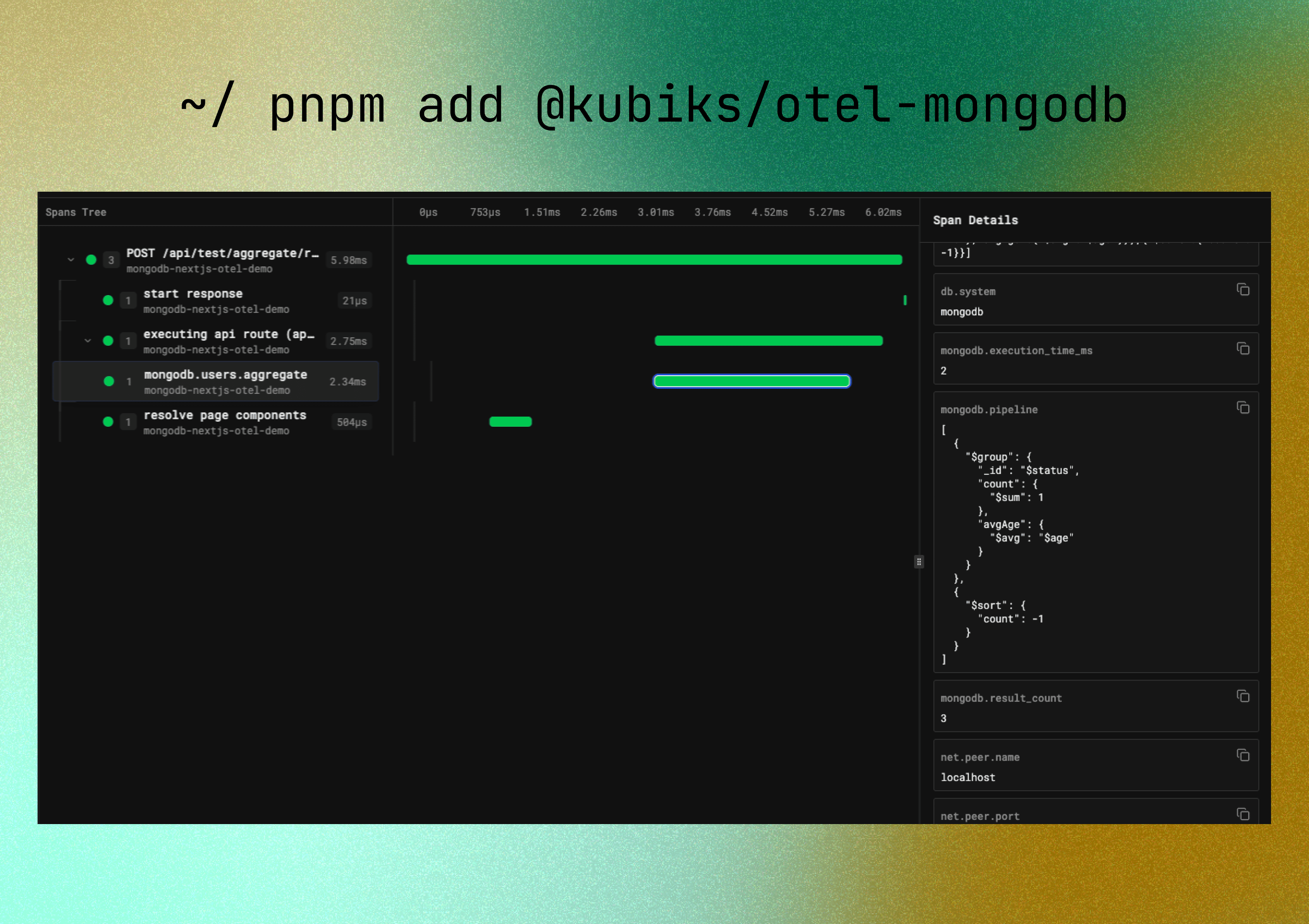 Visualize your MongoDB operations with detailed span information including collection names, operation types, and execution metrics.
## Installation
```bash npm theme={null}
npm install @kubiks/otel-mongodb
```
```bash pnpm theme={null}
pnpm add @kubiks/otel-mongodb
```
```bash yarn theme={null}
yarn add @kubiks/otel-mongodb
```
**Peer Dependencies:** `@opentelemetry/api` >= 1.9.0, `mongodb` >= 5.0.0
## Quick Start
```typescript theme={null}
import { MongoClient } from "mongodb";
import { instrumentMongoClient } from "@kubiks/otel-mongodb";
const client = new MongoClient(process.env.MONGODB_URI!);
await client.connect();
instrumentMongoClient(client, {
captureFilters: true,
peerName: "mongodb.example.com",
peerPort: 27017,
});
const db = client.db("myapp");
const users = db.collection("users");
const user = await users.findOne({ email: "user@example.com" });
```
`instrumentMongoClient` wraps the client you already use—no configuration changes needed. Every database operation creates a client span with useful attributes.
## What Gets Traced
This instrumentation automatically traces all major MongoDB operations including:
`find`, `findOne`
`insertOne`, `insertMany`
`updateOne`, `updateMany`, `findOneAndUpdate`
`deleteOne`, `deleteMany`, `findOneAndDelete`
`aggregate`
`countDocuments`
## Configuration
### With Filter Capture
```typescript theme={null}
instrumentMongoClient(client, {
captureFilters: true, // Capture query filters (default: false)
peerName: "mongodb.example.com",
peerPort: 27017,
});
```
Filter capture is **disabled by default** to protect sensitive data. Only enable in secure, development environments or ensure filters don't contain sensitive information.
## Span Attributes
Each span includes rich metadata about the database operation following OpenTelemetry semantic conventions:
| Attribute | Description | Example |
| --------------------------- | ------------------------------------- | ----------------------- |
| `db.system` | Constant value `mongodb` | `mongodb` |
| `db.operation` | MongoDB operation type | `findOne`, `insertMany` |
| `db.mongodb.collection` | Collection name | `users` |
| `db.name` | Database name | `myapp` |
| `net.peer.name` | MongoDB server hostname | `mongodb.example.com` |
| `net.peer.port` | MongoDB server port | `27017` |
| `mongodb.filter` | Query filter (when enabled) | `{"status":"active"}` |
| `mongodb.result_count` | Number of documents returned | `42` |
| `mongodb.inserted_count` | Number of documents inserted | `5` |
| `mongodb.matched_count` | Number of documents matched (updates) | `10` |
| `mongodb.modified_count` | Number of documents modified | `8` |
| `mongodb.deleted_count` | Number of documents deleted | `15` |
| `mongodb.execution_time_ms` | Query execution time (when enabled) | `42.5` |
| `mongodb.pipeline` | Aggregation pipeline | `[{"$match":...}]` |
The instrumentation captures query metadata to help with debugging and monitoring, while optionally capturing filters based on your security requirements.
## Usage Examples
### Basic Find Operations
```typescript Find One theme={null}
import { users } from "@/lib/mongodb";
const user = await users.findOne({ email: "user@example.com" });
// Traced with:
// - db.operation: "findOne"
// - db.mongodb.collection: "users"
// - mongodb.result_count: 1
```
```typescript Find Many theme={null}
const activeUsers = await users.find({ status: "active" }).toArray();
// Traced with:
// - db.operation: "find"
// - db.mongodb.collection: "users"
// - mongodb.result_count: 42
// - mongodb.filter: {"status":"active"} (if captureFilters: true)
```
```typescript With Projection theme={null}
const users = await collection.find(
{ status: "active" },
{ projection: { name: 1, email: 1 } }
).toArray();
// Traced with projection metadata
```
### Insert Operations
```typescript Insert One theme={null}
const result = await users.insertOne({
name: "John Doe",
email: "john@example.com",
status: "active",
});
// Traced with:
// - db.operation: "insertOne"
// - mongodb.inserted_count: 1
```
```typescript Insert Many theme={null}
const result = await users.insertMany([
{ name: "John", email: "john@example.com" },
{ name: "Jane", email: "jane@example.com" },
{ name: "Bob", email: "bob@example.com" },
]);
// Traced with:
// - db.operation: "insertMany"
// - mongodb.inserted_count: 3
```
### Update Operations
```typescript Update One theme={null}
const result = await users.updateOne(
{ email: "user@example.com" },
{ $set: { status: "inactive" } }
);
// Traced with:
// - db.operation: "updateOne"
// - mongodb.matched_count: 1
// - mongodb.modified_count: 1
```
```typescript Update Many theme={null}
const result = await users.updateMany(
{ status: "pending" },
{ $set: { status: "active" } }
);
// Traced with:
// - db.operation: "updateMany"
// - mongodb.matched_count: 10
// - mongodb.modified_count: 10
```
```typescript Find and Update theme={null}
const user = await users.findOneAndUpdate(
{ email: "user@example.com" },
{ $set: { lastLogin: new Date() } },
{ returnDocument: "after" }
);
// Traced with:
// - db.operation: "findOneAndUpdate"
// - mongodb.matched_count: 1
// - mongodb.modified_count: 1
```
### Delete Operations
```typescript Delete One theme={null}
const result = await users.deleteOne({ email: "user@example.com" });
// Traced with:
// - db.operation: "deleteOne"
// - mongodb.deleted_count: 1
```
```typescript Delete Many theme={null}
const result = await users.deleteMany({ status: "inactive" });
// Traced with:
// - db.operation: "deleteMany"
// - mongodb.deleted_count: 15
```
### Aggregation Pipeline
```typescript theme={null}
const pipeline = [
{ $match: { status: "active" } },
{ $group: { _id: "$country", count: { $sum: 1 } } },
{ $sort: { count: -1 } },
{ $limit: 10 },
];
const results = await users.aggregate(pipeline).toArray();
// Traced with:
// - db.operation: "aggregate"
// - mongodb.pipeline: [{"$match":...},{"$group":...}]
// - mongodb.result_count: 10
```
### Count Operations
```typescript Count Documents theme={null}
const count = await users.countDocuments({ status: "active" });
// Traced with:
// - db.operation: "countDocuments"
// - mongodb.result_count: 42
```
```typescript Estimated Count theme={null}
const count = await users.estimatedDocumentCount();
// Traced with:
// - db.operation: "estimatedDocumentCount"
```
## Complete Integration Example
Here's a complete example of MongoDB with OpenTelemetry in a Next.js application:
### Setup
```typescript lib/mongodb.ts theme={null}
import { MongoClient } from "mongodb";
import { instrumentMongoClient } from "@kubiks/otel-mongodb";
if (!process.env.MONGODB_URI) {
throw new Error("MONGODB_URI environment variable is not set");
}
const client = new MongoClient(process.env.MONGODB_URI);
let clientPromise: Promise;
if (process.env.NODE_ENV === "development") {
// In development, use a global variable to preserve the connection
let globalWithMongo = global as typeof globalThis & {
_mongoClientPromise?: Promise;
};
if (!globalWithMongo._mongoClientPromise) {
clientPromise = client.connect();
instrumentMongoClient(client, {
captureFilters: true,
peerName: new URL(process.env.MONGODB_URI).hostname,
peerPort: parseInt(new URL(process.env.MONGODB_URI).port || "27017"),
});
globalWithMongo._mongoClientPromise = clientPromise;
} else {
clientPromise = globalWithMongo._mongoClientPromise;
}
} else {
// In production, create a new connection
clientPromise = client.connect();
instrumentMongoClient(client, {
captureFilters: false, // Disable in production
peerName: new URL(process.env.MONGODB_URI).hostname,
peerPort: parseInt(new URL(process.env.MONGODB_URI).port || "27017"),
});
}
export default clientPromise;
export async function getDatabase() {
const client = await clientPromise;
return client.db("myapp");
}
export async function getCollection(name: string) {
const db = await getDatabase();
return db.collection(name);
}
```
### Usage in Server Actions
```typescript app/actions/users.ts theme={null}
"use server";
import { getCollection } from "@/lib/mongodb";
import { ObjectId } from "mongodb";
export async function getUser(userId: string) {
const users = await getCollection("users");
return await users.findOne({ _id: new ObjectId(userId) });
}
export async function createUser(data: { name: string; email: string }) {
const users = await getCollection("users");
const result = await users.insertOne({
...data,
createdAt: new Date(),
status: "active",
});
return { id: result.insertedId.toString() };
}
export async function updateUser(userId: string, data: Partial<{ name: string; email: string }>) {
const users = await getCollection("users");
const result = await users.updateOne(
{ _id: new ObjectId(userId) },
{ $set: { ...data, updatedAt: new Date() } }
);
return { success: result.modifiedCount > 0 };
}
export async function deleteUser(userId: string) {
const users = await getCollection("users");
const result = await users.deleteOne({ _id: new ObjectId(userId) });
return { success: result.deletedCount > 0 };
}
export async function getActiveUsers() {
const users = await getCollection("users");
return await users.find({ status: "active" }).toArray();
}
```
### Usage in API Routes
```typescript app/api/stats/route.ts theme={null}
import { NextResponse } from "next/server";
import { getCollection } from "@/lib/mongodb";
export async function GET() {
const users = await getCollection("users");
const stats = await users.aggregate([
{
$group: {
_id: "$status",
count: { $sum: 1 },
},
},
{
$project: {
status: "$_id",
count: 1,
_id: 0,
},
},
]).toArray();
return NextResponse.json({ stats });
}
```
## Best Practices
Always reuse the MongoDB client connection rather than creating new connections:
```typescript theme={null}
// Good: Reuse client
const client = await clientPromise;
// Bad: Create new client each time
const client = new MongoClient(uri);
await client.connect();
```
Only enable filter capture in development or when filters don't contain sensitive data:
```typescript theme={null}
instrumentMongoClient(client, {
captureFilters: process.env.NODE_ENV === "development",
});
```
Ensure proper indexes are created for frequently queried fields:
```typescript theme={null}
await users.createIndex({ email: 1 }, { unique: true });
await users.createIndex({ status: 1 });
```
Always handle MongoDB errors in your application:
```typescript theme={null}
try {
const user = await users.findOne({ email });
if (!user) {
throw new Error("User not found");
}
return user;
} catch (error) {
console.error("MongoDB error:", error);
throw error;
}
```
## Troubleshooting
Ensure OpenTelemetry is initialized before connecting to MongoDB:
```typescript theme={null}
import { NodeSDK } from "@opentelemetry/sdk-node";
const sdk = new NodeSDK({
// ... configuration
});
sdk.start();
// Then connect to MongoDB
const client = await clientPromise;
```
Make sure your MongoDB URI is correct and the server is accessible:
```bash theme={null}
MONGODB_URI=mongodb://localhost:27017/myapp
# or for MongoDB Atlas:
MONGODB_URI=mongodb+srv://username:password@cluster.mongodb.net/myapp
```
Ensure you've configured peer information:
```typescript theme={null}
instrumentMongoClient(client, {
peerName: "mongodb.example.com",
peerPort: 27017,
});
```
## Resources
Learn more about MongoDB Node.js driver
View source code and examples
View package on npm
Found a bug? Let us know!
## License
MIT
Visualize your MongoDB operations with detailed span information including collection names, operation types, and execution metrics.
## Installation
```bash npm theme={null}
npm install @kubiks/otel-mongodb
```
```bash pnpm theme={null}
pnpm add @kubiks/otel-mongodb
```
```bash yarn theme={null}
yarn add @kubiks/otel-mongodb
```
**Peer Dependencies:** `@opentelemetry/api` >= 1.9.0, `mongodb` >= 5.0.0
## Quick Start
```typescript theme={null}
import { MongoClient } from "mongodb";
import { instrumentMongoClient } from "@kubiks/otel-mongodb";
const client = new MongoClient(process.env.MONGODB_URI!);
await client.connect();
instrumentMongoClient(client, {
captureFilters: true,
peerName: "mongodb.example.com",
peerPort: 27017,
});
const db = client.db("myapp");
const users = db.collection("users");
const user = await users.findOne({ email: "user@example.com" });
```
`instrumentMongoClient` wraps the client you already use—no configuration changes needed. Every database operation creates a client span with useful attributes.
## What Gets Traced
This instrumentation automatically traces all major MongoDB operations including:
`find`, `findOne`
`insertOne`, `insertMany`
`updateOne`, `updateMany`, `findOneAndUpdate`
`deleteOne`, `deleteMany`, `findOneAndDelete`
`aggregate`
`countDocuments`
## Configuration
### With Filter Capture
```typescript theme={null}
instrumentMongoClient(client, {
captureFilters: true, // Capture query filters (default: false)
peerName: "mongodb.example.com",
peerPort: 27017,
});
```
Filter capture is **disabled by default** to protect sensitive data. Only enable in secure, development environments or ensure filters don't contain sensitive information.
## Span Attributes
Each span includes rich metadata about the database operation following OpenTelemetry semantic conventions:
| Attribute | Description | Example |
| --------------------------- | ------------------------------------- | ----------------------- |
| `db.system` | Constant value `mongodb` | `mongodb` |
| `db.operation` | MongoDB operation type | `findOne`, `insertMany` |
| `db.mongodb.collection` | Collection name | `users` |
| `db.name` | Database name | `myapp` |
| `net.peer.name` | MongoDB server hostname | `mongodb.example.com` |
| `net.peer.port` | MongoDB server port | `27017` |
| `mongodb.filter` | Query filter (when enabled) | `{"status":"active"}` |
| `mongodb.result_count` | Number of documents returned | `42` |
| `mongodb.inserted_count` | Number of documents inserted | `5` |
| `mongodb.matched_count` | Number of documents matched (updates) | `10` |
| `mongodb.modified_count` | Number of documents modified | `8` |
| `mongodb.deleted_count` | Number of documents deleted | `15` |
| `mongodb.execution_time_ms` | Query execution time (when enabled) | `42.5` |
| `mongodb.pipeline` | Aggregation pipeline | `[{"$match":...}]` |
The instrumentation captures query metadata to help with debugging and monitoring, while optionally capturing filters based on your security requirements.
## Usage Examples
### Basic Find Operations
```typescript Find One theme={null}
import { users } from "@/lib/mongodb";
const user = await users.findOne({ email: "user@example.com" });
// Traced with:
// - db.operation: "findOne"
// - db.mongodb.collection: "users"
// - mongodb.result_count: 1
```
```typescript Find Many theme={null}
const activeUsers = await users.find({ status: "active" }).toArray();
// Traced with:
// - db.operation: "find"
// - db.mongodb.collection: "users"
// - mongodb.result_count: 42
// - mongodb.filter: {"status":"active"} (if captureFilters: true)
```
```typescript With Projection theme={null}
const users = await collection.find(
{ status: "active" },
{ projection: { name: 1, email: 1 } }
).toArray();
// Traced with projection metadata
```
### Insert Operations
```typescript Insert One theme={null}
const result = await users.insertOne({
name: "John Doe",
email: "john@example.com",
status: "active",
});
// Traced with:
// - db.operation: "insertOne"
// - mongodb.inserted_count: 1
```
```typescript Insert Many theme={null}
const result = await users.insertMany([
{ name: "John", email: "john@example.com" },
{ name: "Jane", email: "jane@example.com" },
{ name: "Bob", email: "bob@example.com" },
]);
// Traced with:
// - db.operation: "insertMany"
// - mongodb.inserted_count: 3
```
### Update Operations
```typescript Update One theme={null}
const result = await users.updateOne(
{ email: "user@example.com" },
{ $set: { status: "inactive" } }
);
// Traced with:
// - db.operation: "updateOne"
// - mongodb.matched_count: 1
// - mongodb.modified_count: 1
```
```typescript Update Many theme={null}
const result = await users.updateMany(
{ status: "pending" },
{ $set: { status: "active" } }
);
// Traced with:
// - db.operation: "updateMany"
// - mongodb.matched_count: 10
// - mongodb.modified_count: 10
```
```typescript Find and Update theme={null}
const user = await users.findOneAndUpdate(
{ email: "user@example.com" },
{ $set: { lastLogin: new Date() } },
{ returnDocument: "after" }
);
// Traced with:
// - db.operation: "findOneAndUpdate"
// - mongodb.matched_count: 1
// - mongodb.modified_count: 1
```
### Delete Operations
```typescript Delete One theme={null}
const result = await users.deleteOne({ email: "user@example.com" });
// Traced with:
// - db.operation: "deleteOne"
// - mongodb.deleted_count: 1
```
```typescript Delete Many theme={null}
const result = await users.deleteMany({ status: "inactive" });
// Traced with:
// - db.operation: "deleteMany"
// - mongodb.deleted_count: 15
```
### Aggregation Pipeline
```typescript theme={null}
const pipeline = [
{ $match: { status: "active" } },
{ $group: { _id: "$country", count: { $sum: 1 } } },
{ $sort: { count: -1 } },
{ $limit: 10 },
];
const results = await users.aggregate(pipeline).toArray();
// Traced with:
// - db.operation: "aggregate"
// - mongodb.pipeline: [{"$match":...},{"$group":...}]
// - mongodb.result_count: 10
```
### Count Operations
```typescript Count Documents theme={null}
const count = await users.countDocuments({ status: "active" });
// Traced with:
// - db.operation: "countDocuments"
// - mongodb.result_count: 42
```
```typescript Estimated Count theme={null}
const count = await users.estimatedDocumentCount();
// Traced with:
// - db.operation: "estimatedDocumentCount"
```
## Complete Integration Example
Here's a complete example of MongoDB with OpenTelemetry in a Next.js application:
### Setup
```typescript lib/mongodb.ts theme={null}
import { MongoClient } from "mongodb";
import { instrumentMongoClient } from "@kubiks/otel-mongodb";
if (!process.env.MONGODB_URI) {
throw new Error("MONGODB_URI environment variable is not set");
}
const client = new MongoClient(process.env.MONGODB_URI);
let clientPromise: Promise;
if (process.env.NODE_ENV === "development") {
// In development, use a global variable to preserve the connection
let globalWithMongo = global as typeof globalThis & {
_mongoClientPromise?: Promise;
};
if (!globalWithMongo._mongoClientPromise) {
clientPromise = client.connect();
instrumentMongoClient(client, {
captureFilters: true,
peerName: new URL(process.env.MONGODB_URI).hostname,
peerPort: parseInt(new URL(process.env.MONGODB_URI).port || "27017"),
});
globalWithMongo._mongoClientPromise = clientPromise;
} else {
clientPromise = globalWithMongo._mongoClientPromise;
}
} else {
// In production, create a new connection
clientPromise = client.connect();
instrumentMongoClient(client, {
captureFilters: false, // Disable in production
peerName: new URL(process.env.MONGODB_URI).hostname,
peerPort: parseInt(new URL(process.env.MONGODB_URI).port || "27017"),
});
}
export default clientPromise;
export async function getDatabase() {
const client = await clientPromise;
return client.db("myapp");
}
export async function getCollection(name: string) {
const db = await getDatabase();
return db.collection(name);
}
```
### Usage in Server Actions
```typescript app/actions/users.ts theme={null}
"use server";
import { getCollection } from "@/lib/mongodb";
import { ObjectId } from "mongodb";
export async function getUser(userId: string) {
const users = await getCollection("users");
return await users.findOne({ _id: new ObjectId(userId) });
}
export async function createUser(data: { name: string; email: string }) {
const users = await getCollection("users");
const result = await users.insertOne({
...data,
createdAt: new Date(),
status: "active",
});
return { id: result.insertedId.toString() };
}
export async function updateUser(userId: string, data: Partial<{ name: string; email: string }>) {
const users = await getCollection("users");
const result = await users.updateOne(
{ _id: new ObjectId(userId) },
{ $set: { ...data, updatedAt: new Date() } }
);
return { success: result.modifiedCount > 0 };
}
export async function deleteUser(userId: string) {
const users = await getCollection("users");
const result = await users.deleteOne({ _id: new ObjectId(userId) });
return { success: result.deletedCount > 0 };
}
export async function getActiveUsers() {
const users = await getCollection("users");
return await users.find({ status: "active" }).toArray();
}
```
### Usage in API Routes
```typescript app/api/stats/route.ts theme={null}
import { NextResponse } from "next/server";
import { getCollection } from "@/lib/mongodb";
export async function GET() {
const users = await getCollection("users");
const stats = await users.aggregate([
{
$group: {
_id: "$status",
count: { $sum: 1 },
},
},
{
$project: {
status: "$_id",
count: 1,
_id: 0,
},
},
]).toArray();
return NextResponse.json({ stats });
}
```
## Best Practices
Always reuse the MongoDB client connection rather than creating new connections:
```typescript theme={null}
// Good: Reuse client
const client = await clientPromise;
// Bad: Create new client each time
const client = new MongoClient(uri);
await client.connect();
```
Only enable filter capture in development or when filters don't contain sensitive data:
```typescript theme={null}
instrumentMongoClient(client, {
captureFilters: process.env.NODE_ENV === "development",
});
```
Ensure proper indexes are created for frequently queried fields:
```typescript theme={null}
await users.createIndex({ email: 1 }, { unique: true });
await users.createIndex({ status: 1 });
```
Always handle MongoDB errors in your application:
```typescript theme={null}
try {
const user = await users.findOne({ email });
if (!user) {
throw new Error("User not found");
}
return user;
} catch (error) {
console.error("MongoDB error:", error);
throw error;
}
```
## Troubleshooting
Ensure OpenTelemetry is initialized before connecting to MongoDB:
```typescript theme={null}
import { NodeSDK } from "@opentelemetry/sdk-node";
const sdk = new NodeSDK({
// ... configuration
});
sdk.start();
// Then connect to MongoDB
const client = await clientPromise;
```
Make sure your MongoDB URI is correct and the server is accessible:
```bash theme={null}
MONGODB_URI=mongodb://localhost:27017/myapp
# or for MongoDB Atlas:
MONGODB_URI=mongodb+srv://username:password@cluster.mongodb.net/myapp
```
Ensure you've configured peer information:
```typescript theme={null}
instrumentMongoClient(client, {
peerName: "mongodb.example.com",
peerPort: 27017,
});
```
## Resources
Learn more about MongoDB Node.js driver
View source code and examples
View package on npm
Found a bug? Let us know!
## License
MIT